 Wildlife
of Bhutan
Greater One-horned Rhinoceros
Elephants & Rhinos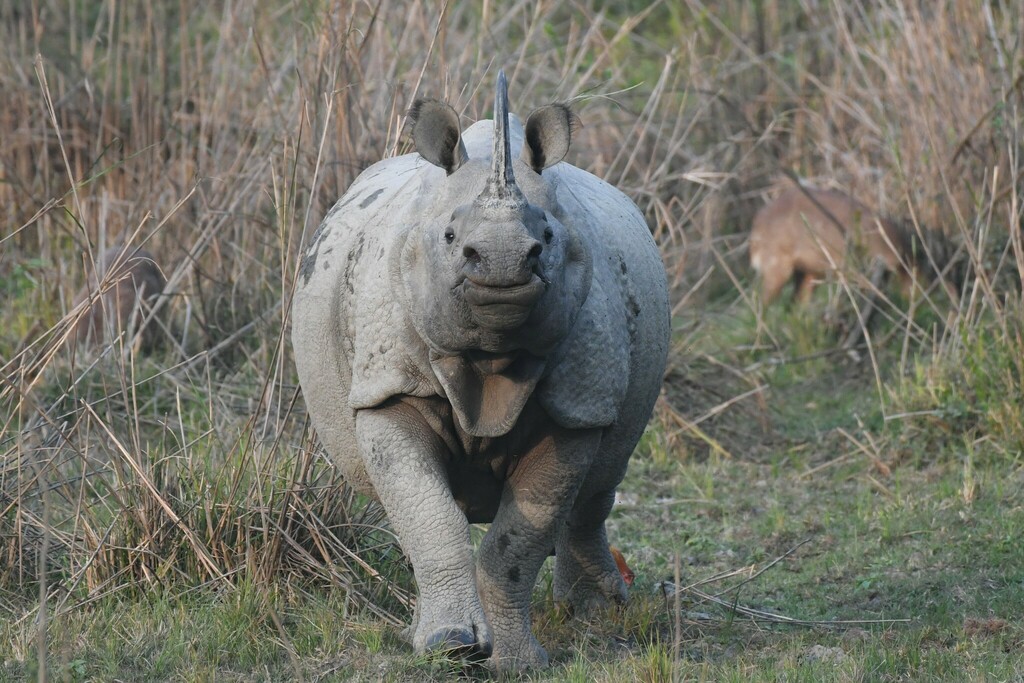
Photo: Tristan Jobin · CC-BY (May be cropped or resized)
Rhinoceros unicornis
Basic stats
Diet
Mainly grass; also twigs, leaves, shrubs, flowers, fruit and aquatic plants
Habitat
Alluvial grassland of the Terai and Brahmaputra basin
Range
Formerly across the northern Indian subcontinent including the southern parts of Bhutan; now mainly India and Nepal
Litter size
A single calf
Gestation period
About 15.7 months
Size
Up to 4.4m long and 2.1m at the shoulder
Weight
Up to 4,000kg
The greater one-horned rhinoceros has thick grey-brown skin with pinkish folds and a single horn that grows up to about 60cm. The upper legs and shoulders are covered in wart-like bumps, and it is almost hairless apart from the eyelashes, ear fringes and tail brush. Among Asian land mammals only the Asian elephant is larger, and the biggest individuals are reported at up to 4,000kg (Wikipedia, general species account).
It once ranged across the whole northern Indian subcontinent, including the southern parts of Nepal and Bhutan. Jerdon wrote in 1867 that it was most abundant in Assam and the Bhutan Dooars. Today the main populations are in India and Nepal, and the sources opened do not describe it in Bhutan now. It is a grazer and largely solitary, with a calf born after about 15.7 months.
Quick answers
- What does the Greater One-horned Rhinoceros eat?
- Mainly grass; also twigs, leaves, shrubs, flowers, fruit and aquatic plants
- What habitat does the Greater One-horned Rhinoceros live in?
- Alluvial grassland of the Terai and Brahmaputra basin
- Where is the Greater One-horned Rhinoceros found?
- Formerly across the northern Indian subcontinent including the southern parts of Bhutan; now mainly India and Nepal
- What is the litter size of the Greater One-horned Rhinoceros?
- A single calf
- How long is the gestation period of the Greater One-horned Rhinoceros?
- About 15.7 months
- How big is the Greater One-horned Rhinoceros?
- Up to 4.4m long and 2.1m at the shoulder
- How much does the Greater One-horned Rhinoceros weigh?
- Up to 4,000kg