 Wildlife
of Bhutan
Amur Stonechat
Thrushes, Chats & Flycatchers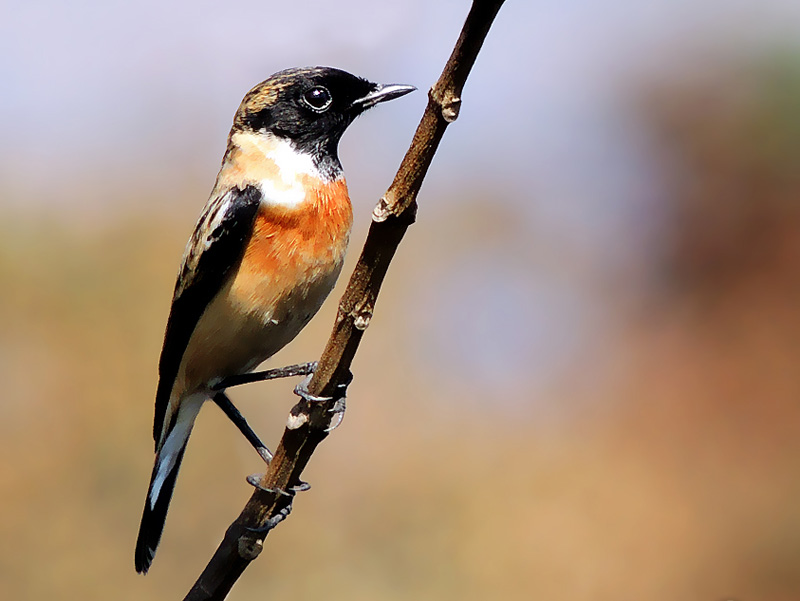
Photo: Shantanu Kuveskar · CC BY-SA 4.0 (May be cropped or resized)
Saxicola stejnegeri
Also known as: Saxicola maurus stejnegeri
AviList (2026) treats this bird as a subspecies, Saxicola maurus stejnegeri, of the Siberian Stonechat (Saxicola maurus), which is also on this site. IOC lists it as a separate species.
Basic stats
Diet
Insects
Habitat
Open rough scrubland or grassland with scattered shrubs, from sea level to about 4,000m
Range
Breeds across temperate Asia from Siberia south to the Himalaya; the Himalayan form indicus breeds from Kashmir to Sikkim and Assam
The Amur stonechat is the form stejnegeri of the Siberian stonechat, which is sometimes treated as its own species; the account used here covers the Siberian stonechat as a whole. Breeding males have a black head and back, a white collar, wing patch and rump, and a small orange throat patch, while females are pale brown with white neck patches and a pale pinkish-yellow rump. The male gives a clicking call like two pebbles knocked together (Wikipedia, general species account).
It breeds in open, rough scrub and grassland from sea level to around 4,000m and is migratory, wintering from southern Japan south to Thailand and India. In the Bhutan foothills, migrants sometimes forage in fields and pastures above 2,000m, but most move further south for winter (Wikipedia, general species account).
Quick answers
- What does the Amur Stonechat eat?
- Insects
- What habitat does the Amur Stonechat live in?
- Open rough scrubland or grassland with scattered shrubs, from sea level to about 4,000m
- Where is the Amur Stonechat found?
- Breeds across temperate Asia from Siberia south to the Himalaya; the Himalayan form indicus breeds from Kashmir to Sikkim and Assam