 Wildlife
of Bhutan
Indian Garden Lizard
Agamids & Forest Lizards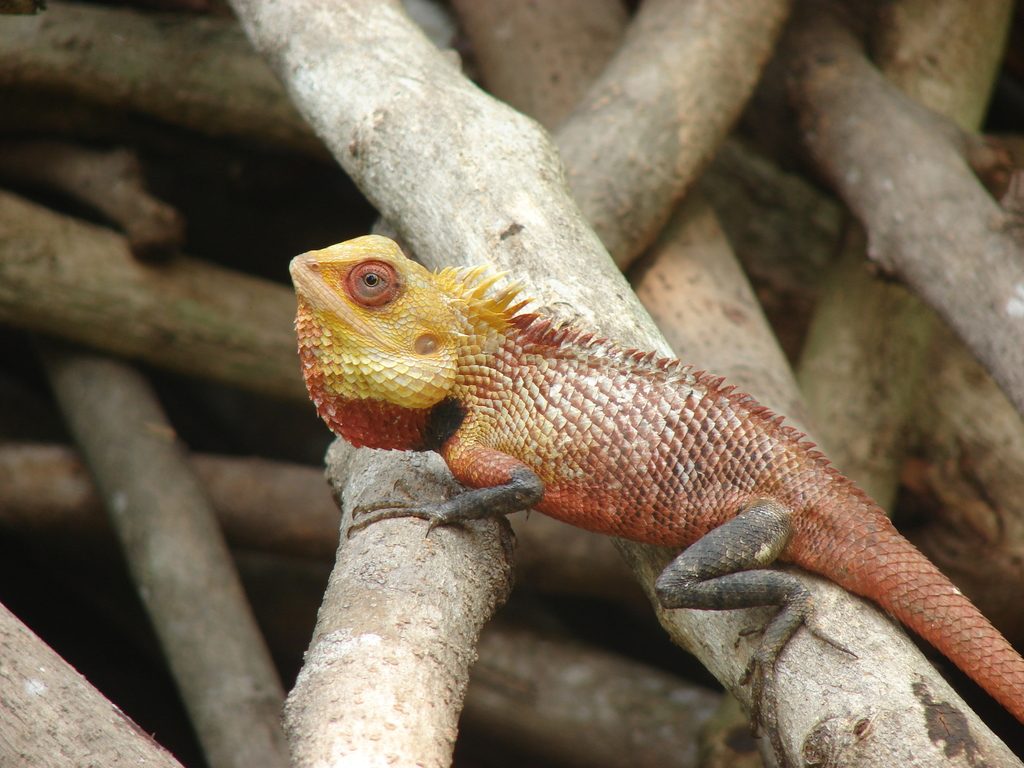
Photo: Devika M B · CC BY 4.0 (May be cropped or resized)
Calotes versicolor
Basic stats
Diet
Insects
Habitat
Eggs buried in moist soil, in tree hollows or burrowed holes
Range
Southeastern Iran and Afghanistan east through India, Bhutan, Nepal and Southeast Asia
Clutch size
About 5–20 eggs
Incubation period
About 6–7 weeks
Size
Over 10cm snout to vent; total length up to 37cm
The oriental garden lizard, also called the bloodsucker or changeable lizard, is an agamid found across a wide range of Asia. Adults measure over 10cm from snout to vent and up to 37cm including the tail. Colour is very variable, from uniform brownish, greyish-olive or yellowish to broad brown bands across the back, and black streaks radiate from the eye across the throat (Wikipedia, general species account).
In the breeding season the male develops a bright red throat. Females lay about five to twenty soft oval eggs, buried in moist soil or in tree hollows or holes they have dug, which hatch in about six to seven weeks. Its native range includes Bhutan as well as India, Nepal, Bangladesh and Pakistan. It feeds on insects.
Quick answers
- What does the Indian Garden Lizard eat?
- Insects
- What habitat does the Indian Garden Lizard live in?
- Eggs buried in moist soil, in tree hollows or burrowed holes
- Where is the Indian Garden Lizard found?
- Southeastern Iran and Afghanistan east through India, Bhutan, Nepal and Southeast Asia
- How many eggs does the Indian Garden Lizard lay?
- About 5–20 eggs
- How long are the eggs of the Indian Garden Lizard incubated?
- About 6–7 weeks
- How big is the Indian Garden Lizard?
- Over 10cm snout to vent; total length up to 37cm